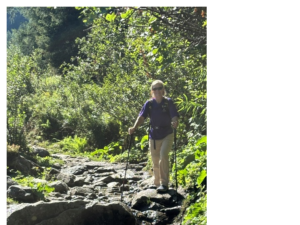
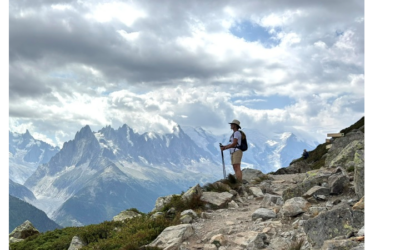
When my sister, Alison, and I hiked the Tour du Mont Blanc (TMB) this summer, one of our primary goals was simple: Stay upright and protect your focus. That may sound like a modest ambition, but on a steep mountain trail covered with loose rocks, roots, boulders, and uneven footing, it requires considerable effort – particularly for two hikers over 60.
Going uphill was physically demanding. Going downhill was trickier. A rock that looked stable could move under your boot. A root could catch your toe. Your knees and quadriceps had to lower your body over rocks and ledges, sometimes for hours. We quickly learned that the most difficult portions of the trail demanded our complete attention. Conversation stopped.
Thoughts about dinner, tomorrow’s weather, work back home, or anything else disappeared. For those few minutes, there was only one question: “Where does my foot go next?” It was a powerful reminder of something that has become increasingly difficult in our working lives: focus.
Engineering managers and leaders are surrounded by demands for their attention. Teams messages arrive. Email accumulates. Someone calls. A meeting notification appears. A staff member has a question. A client needs something. Your phone buzzes. Each interruption may be legitimate. Collectively, however, they can make sustained concentration almost impossible. That matters because our most important work often requires exactly the kind of attention that a difficult mountain trail demands. Strategic thinking requires focus.
Solving a complicated technical problem requires concentration. Writing, planning, analyzing data, preparing for an important conversation, or thinking through a difficult personnel issue all require uninterrupted mental space. Yet many leaders treat focused time as whatever remains after everything else has been handled. Usually, very little remains.
Perhaps we need to reverse the equation. I’ve increasingly noticed people deliberately protecting periods of time for focused work. Some block their calendars. Others schedule appointments with themselves so the time cannot easily be claimed by someone else. Some turn off notifications or set an email message explaining that they are unavailable while doing concentrated work.
The specific method matters less than the intention. On the trail, there are portions where it is perfectly safe to walk and talk. There are other places where you need to stop talking and attend to your feet. Our work is similar. Not every task deserves intense concentration. Answering a routine email probably doesn’t require shutting the office door. But some work does. The challenge for leaders is recognizing the difference – and protecting their attention accordingly.
Ask yourself: “What work on my plate deserves my undivided attention?” Then give yourself permission to create the conditions needed to do it well. Because sometimes the best way to reach an important destination is simply to stop looking at everything else and concentrate on where you put your foot next.

0 Comments