
Leaders, like you, like clarity. Data. Certainty. A clear path forward.
But most of the time, especially during change – certainty is not what you get.
Instead, you’re asked to make decisions with incomplete information, shifting priorities, and pressure to move quickly. You may want to wait for the “right” answer because it feels like responsible leadership. In reality, however, waiting may create more risk than acting.
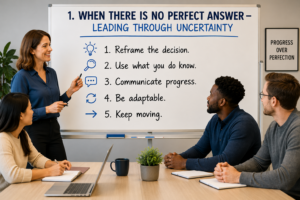
The key point is: there is rarely a perfect decision. The goal is to make the best decision you can with the information available right now. Here are five decision-making tips that make uncertainty more manageable.
- Reframe the decision. Instead of asking, “What’s the right answer?” ask, “What’s a reasonable next step?” That shift lowers the stakes just enough to allow movement. It transforms a high-pressure moment into a manageable action. Progress, even imperfect progress, builds momentum.
- Use what you do know. Even during uncertainty, you have experience, context, and partial data. Combine that background with informed judgment. Leaders are not valued only for what they know, but for how they think. Your team is looking to you for direction, not perfection.
- Communicate progress. During uncertainty, communication (lots of it) is critical. Communicate without creating doubt. You don’t need to present a fully polished answer if one doesn’t exist. Instead, say, “Here’s what we know, here’s what we don’t know, and here’s what we’re doing next.” That creates clarity and stability without overpromising certainty.
- Be adaptable. Not every decision is final. Position decisions as steps, not endpoints. This gives you flexibility to adjust as new information emerges. It also signals to your team that forward movement matters more than getting everything exactly right the first time.
- Keep moving. Momentum builds confidence. When teams see thoughtful action, even in uncertainty, they feel more grounded and less stuck. Inaction, on the other hand, increases anxiety and invites speculation.
Uncertainty isn’t going away. If anything, it’s becoming the norm. The leaders who succeed aren’t the ones who wait for clarity—they’re the ones who take thoughtful, steady action in spite of uncertainty.

0 Comments